The Hired Gun
Where is IBM? The End of The Electronic Golden Age
Prelude (The tech arch from the past)
Consumer tech feels more restrictive than it did 30 years ago, and it's not just nostalgia.
We had it all - Circuit City, Best Buy, RadioShack, Micro Center, and a hundred local shops. You didn't just pick your PC, you picked every part inside it. New processors and graphics cards every few weeks. Games on shelves, not on launchers, and when you bought one, you owned it forever.
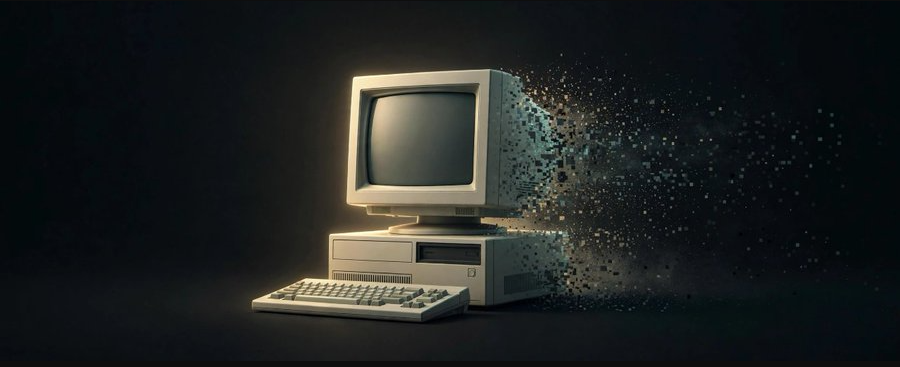
This wasn't just a hobbyist thing. That beige IBM-compatible box reshaped everything. It rewrote education, the job market, news and media, movie production, even the trades. Your HVAC guy was suddenly running load calculations on a 486. Your machine shop was running on QuickBASIC. All markets were touched by the IBM computer.
Because the kingdom that held the lands was under a different reign.
IBM, Intel, and Microsoft were built on one mantra: a PC in every home and a mainframe in every business. IBM's PC division was the GOLD STANDARD.
This was Microsoft in its prime, untouchable by Apple. Linux existed, but it lived in server rooms - it wasn't the formalized force it is today. The entire culture was built on one rock-solid, open, 32-bit x86 architecture.
And that openness is what built the homelab community in the first place. So how did we lose it?
A Series of Bad Decisions (they didn't embrace open)
They had the chance to be Red Hat, GitHub, and Arduino combined, 15 years early. They just didn't want to be.
The decision that matters isn't MCA or OS/2. It's what they did after.
Think about it:
1. They fought the clones instead of feeding them. The clone market was the first true open-source hardware movement. Compaq reverse-engineered the BIOS clean-room style. Instead of saying "fine, we are the standard, pay us $5 per board and we'll certify you," IBM sued them. If they'd leaned in, every clone would have said " IBM Compatible" and sent IBM a check. They chose royalties over reach.
2. They tried to close what they had opened. MCA was the symptom. OS/2 was the same logic - "we need to own the OS again." At the exact moment Richard Stallman is writing the GPL and Linus is posting about a hobby OS, IBM had the resources to make OS/2 open source and make the x86 stack completely open, top to bottom. They didn't. Microsoft did the opposite - they let Windows be pirated and put it on everything.
3. They missed Linux until it was a server story. This is the irony you'll want to hit hard in the article. IBM did finally lean into open source - in 2001 they famously invested $1 billion in Linux. It saved their mainframe and server business. But they only did it for enterprise. They never brought that philosophy back down to the consumer PC. They never made the ThinkPad an open hardware platform. They never let the community own it.
Nobody Learned - History Repeats
NVIDIA is the new IBM. They built the open standard by accident. CUDA became the x86 of AI because it was everywhere and it worked. Just like IBM-compatible.
Now? Closed driver stack, proprietary CUDA lock-in, trying to own the whole rack with NVLink, DGX. And what is the entire market doing? Exactly what Compaq did. AMD with ROCm, Intel with OneAPI, a hundred startups writing a clean-room CUDA translator. The entire industry is working full-time to reverse-engineer NVIDIA the way Compaq reverse-engineered IBM】.
They're choosing royalties over reach again.
Meta, xAI, and Anthropic are the new Microsoft.
Microsoft's play was: let Windows be everywhere, then lock in the ecosystem. Everyone in AI ran the same play:
Meta did it with Llama. Gave away Llama 2 to make Llama the standard, then Llama 3/4 comes with commercial restrictions and a closed frontier push.
xAI did it with Grok. Open-sourced Grok-1 in March 2024 to get credibility as the "open" alternative, then Grok-2 and Grok-3 go fully closed and tied to X.
Anthropic did it with Claude. Started as the safety-focused, open-research lab founded by ex-OpenAI folks, now Claude 3.5 and 4 are fully closed, no weights, API-only, and the safety papers slowed down.
Same logic as OS/2: "We need to own the OS again."
And the market is doing the same thing - Mistral, Qwen, DeepSeek, all the Compaqs of this era, eating it from below because the community wants actually open.
IBM's final form is the most telling. They spent $34 billion to buy Red Hat in 2019. They had to buy the open source crown they could have had for free in 1991.
And what did they do after? Started closing Red Hat. Putting RHEL source behind a paywall, killing CentOS. They learned open source could save them, then immediately tried to close it again. They still haven't learned.
Comments 0 in this thread